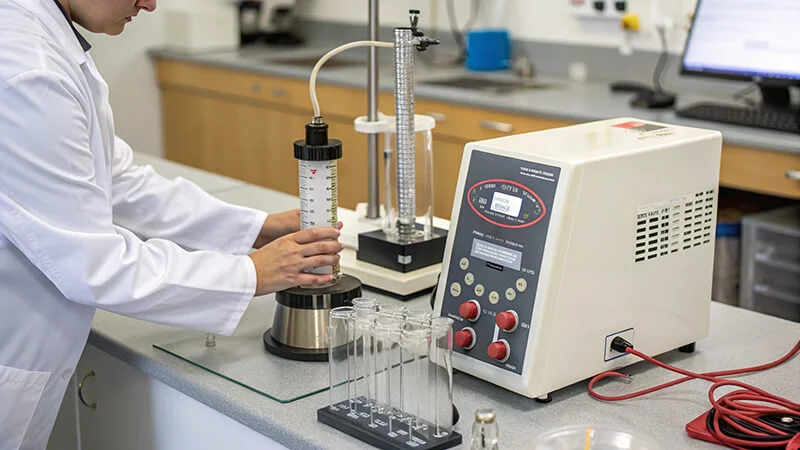
Your factory is warm during the day. Your oil flows freely. Your filler hits the target weight every time. Then winter arrives. Monday morning. The factory is cold from the weekend shutdown. Your oil is thick. It flows slowly. Your essential oil filling machine opens the valve for the same amount of time. Less oil comes out. Underfill. Every bottle is short. Your customer notices. They complain. The problem is not your filler. It is the lack of temperature control. Oil viscosity changes with temperature. Significantly. A ten degree drop can double viscosity. Your fill timing must compensate. Or your oil temperature must stay constant. A jacketed hopper with warm water circulation maintains a steady temperature. Your oil flows consistently. Your fill weights stay accurate. Ask your supplier about temperature control options. If they offer none, your winter fills will be wrong. Every year. Add thermal control. Your accuracy will survive the seasons.
The Summer Heat That Thins Everything
Afternoon in July. Your factory is hot. Your oil is thin. It flows fast. Your essential oil filling machine opens the valve for the same amount of time. Too much oil comes out. Overfill. You are giving away product. Your profit margin shrinks. The same problem. Temperature. But now the oil is too warm. The solution is the same. Temperature control. A jacketed hopper with chilled water circulation keeps your oil cool. Or a viscosity feedback system measures the oil’s flow rate and adjusts fill timing in real time. Ask your supplier about viscosity compensation. If their filler uses only timed filling, your weights will drift with every degree of temperature change. Not a little. A lot. Essential oils change viscosity dramatically with temperature. Your filler must adapt. Or you must control the temperature. Do one or the other. Doing nothing is not an option.
The Batch Variation That Comes From Your Supplier
Your oil supplier changes. Or their process changes. The viscosity of your peppermint oil this month is different from last month. Your filler does not know. It uses the same timing. The fill weight changes. Your essential oil filling machine with timed filling cannot adapt to batch variation. The solution is weight-based filling. The filler weighs the bottle during filling. It stops when the target weight is reached. Viscosity does not matter. Temperature does not matter. Batch variation does not matter. The scale decides. Ask your supplier about in-process weighing. If they offer only timed filling, your accuracy depends on consistent viscosity. Your supplier cannot guarantee that. Not because they are bad. Because essential oils are natural products. They vary. Your filler must handle that variation. Weight-based filling is the answer.
The Pressure Drift That Changes With Hopper Level
Your hopper is full. The pressure at the fill valve is high. Oil flows fast. Your hopper is nearly empty. The pressure is low. Oil flows slowly. Your essential oil filling machine uses the same valve open time. The fill weight changes. Underfill when the hopper is low. Overfill when it is full. The solution is a constant pressure system. A level sensor keeps the hopper within a narrow range. Or a pump maintains constant pressure regardless of hopper level. Or you use weight-based filling that ignores pressure changes. Ask your supplier about pressure compensation. If their filler has no method to handle pressure variation, your fill weights will drift as the hopper empties. Your operator will constantly adjust timing. That is not automation. That is manual labor disguised as automation. Constant pressure or weight-based filling. Your choice. But choose one.
The Pump Wear That Changes Flow Rate Over Time
Your filler uses a pump. The pump wears. The clearance increases. The flow rate decreases. Your essential oil filling machine uses the same pump speed. Less oil moves. Underfill. You do not notice because the wear is gradual. Your customers notice. They get short bottles. The problem is open-loop control. The pump runs at a set speed. The filler assumes the flow rate is constant. It is not. The solution is flow monitoring. A flow meter measures actual flow. The filler adjusts pump speed to maintain target flow. Or use weight-based filling that does not care about flow rate. Ask your supplier about flow feedback. If their pump runs open-loop, your fill weights will drift as the pump wears. Not if. When. All pumps wear. Your filler must compensate. Closed-loop control or weight-based filling. No other options.
The One Test That Quantifies Your Viscosity Problem
Run your essential oil filling machine at the start of a shift. Record the fill weight of fifty bottles. Calculate the average and standard deviation. Now run again after the factory has warmed up five degrees. Record another fifty bottles. Compare the averages. The difference is your temperature sensitivity. If the average changed by more than one percent, your filler is too sensitive to temperature. Now run with the hopper full. Record fifty bottles. Run with the hopper nearly empty. Compare. The difference is your pressure sensitivity. Now run with a fresh pump. Record. Run after one month of production. Compare. The difference is your wear sensitivity. This test takes one day. It reveals every weakness in your filling system. A good essential oil filling machine shows no significant difference in any of these tests. A bad machine shows large differences. Run the test before you buy. Run it on your current machine. Run it after installation. The data tells the truth. Your fill accuracy depends on controlling viscosity, temperature, pressure, and wear. Measure each. Compensate for each. Your customers will get exactly what they paid for. Every bottle. Every season. Every batch. That is the standard. Meet it.