Two years ago, if you had typed “vibe coding game” into a search engine, you would have found nothing. The phrase did not exist as a category, a movement, or even a recognisable style. Today, it describes one of the fastest-growing approaches to independent game creation — and understanding what it actually means requires separating it from the hype that has attached itself to the term.
A vibe coding game is not a specific genre, a particular art style, or a game built with any one tool. It is a philosophy of creation. The creator starts with a feeling — an emotional or aesthetic tone they want the player to experience — and builds the game outward from that feeling rather than from a mechanical or technical specification. The vibe comes first. The mechanics, the visuals, and the systems emerge from it rather than defining it.
Vibe Coding vs Traditional Development: A Fundamental Shift in Approach
Traditional game development typically begins with systems. What is the core mechanic? What is the win condition? What genre does this belong to? These are the foundational questions, and the answers to them shape every subsequent decision — the visual style that fits the genre, the audio that supports the mechanic, the pacing that suits the win condition. The feeling the player has while playing emerges from the sum of these decisions, but it is rarely the starting point.
Vibe coding inverts this sequence entirely. The starting point is a feeling — something lonely and quiet, something overwhelming and chaotic, something nostalgic and warm. The mechanic, the genre, and the win condition all become secondary considerations that serve the feeling rather than defining it. This is not a lesser approach to game design; it is a genuinely different one that produces games with a different kind of coherence and emotional impact.
Making Your First Vibe Coding Game With Combos
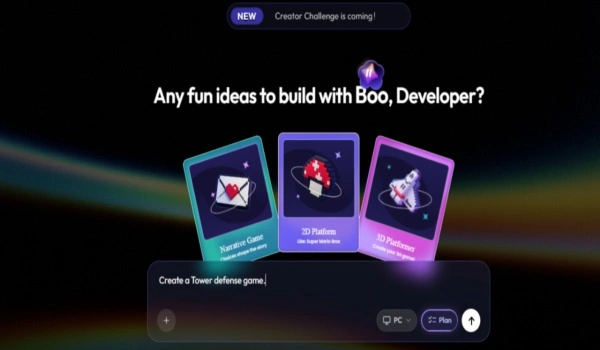
Combos is particularly well-suited to the vibe coding game approach because its AI game agent Boo, is built to interpret emotional and aesthetic intent, not just mechanical specifications. Here is exactly how the process works.
Step 1 — Start With a Feeling: Go to combos.fun — instead of planning mechanics first, start with a feeling: “something lonely and underwater” or “frantic and neon-lit.” Let that emotional direction lead the description entirely.
Step 2 — Let the Vibe Lead the GDD: Allow that description to drive Boo’s Game Design Document without correcting it toward genre conventions. The GDD that results from a vibe-first prompt will be different from a mechanics-first one — and that difference is the point.
Step 3 — Review for Aesthetics First: Review the generated world and assets with atmosphere in mind rather than gameplay function. Ask whether the visual output matches the feeling you described before asking whether the mechanics are balanced.
Step 4 — Publish Quickly: Publish quickly rather than over-refining. Vibe coding games are meant to be felt and experienced — they lose something in prolonged perfectionism. Ship when the feeling is right, not when every technical detail is resolved.
The Feel-First Philosophy Behind It
The feel-first philosophy of vibe coding game creation is not anti-design. It is a recognition that emotional coherence is as legitimate a design goal as mechanical elegance. Many of the games that have made the strongest cultural impact did so not because their systems were the most sophisticated, but because they produced a specific, distinctive feeling that players found impossible to describe to someone else without saying, “you just have to play it.”
Creating from a feeling forces a kind of honesty about what you are actually trying to achieve. It strips away the safety of genre conventions and mechanical templates and asks a more fundamental question: what do you want the person playing this to feel? Everything that follows is in service of that answer.
Are Vibe Coding Games Real Games? The Debate Worth Having
There is a real debate in game development communities about whether vibe coding games constitute genuine games or whether they are closer to interactive experiences, art projects, or tech demos. This debate is worth engaging with honestly rather than dismissing.
The argument that they are not “real games” usually centres on their relationship to mechanical challenge — the claim that a game without meaningful failure conditions, escalating difficulty, or skill-based progression is not a game in the full sense. The counterargument is that interactivity itself is sufficient, and that the definition of games has always been contested enough that policing its edges does more harm than good. Both positions have merit, and the most honest answer is that the label matters less than whether what is created is worth experiencing.
Why This Trend Is Not Going Anywhere
The vibe coding game trend has staying power because it solves a real problem: it gives creators who think in terms of feelings rather than systems a legitimate path into game creation. Artists, musicians, writers, and designers who previously found the mechanical and technical language of game development alienating now have an entry point that speaks their native creative language.
As AI tools for game creation become more capable at interpreting emotional and aesthetic intent — as Boo on Combos already does — the quality ceiling for vibe coding games will continue to rise. The gap between a technically sophisticated conventional game and an emotionally coherent vibe game will continue to close. The trend is not a passing novelty. It is a genuine expansion of what game creation means and who it belongs to.
Conclusion
A vibe coding game is not a simpler game or a lesser game — it is a game built around a different kind of creative intent. In 2026, with tools like Combos making it possible to translate feelings directly into playable experiences without a technical intermediate step, the vibe coding approach has become one of the most accessible and creatively honest paths into game development available. If you have a feeling you want to turn into something playable, this is where you start.