One of those issues that appears to be a product defect but is rarely the case is condensation beneath a polycarbonate roof. The sheets are fine, according to the majority of homeowners who contact providers about it. The installation has a gap somewhere.
So, condensation under polycarbonate roofing is an installation issue, and that means it is fixable. This guide explains why it happens and exactly what to do about it.
Two Types of Condensation, and Why the Difference Matters
The most crucial thing to comprehend before attempting any remedy is this distinction, which the majority of recommendations completely ignore.
Internal condensation
It forms inside the hollow chambers of the sheet itself. It looks like a foggy or wet appearance trapped inside the panel. You can see it but cannot reach it without removing the sheet.
Surface condensation
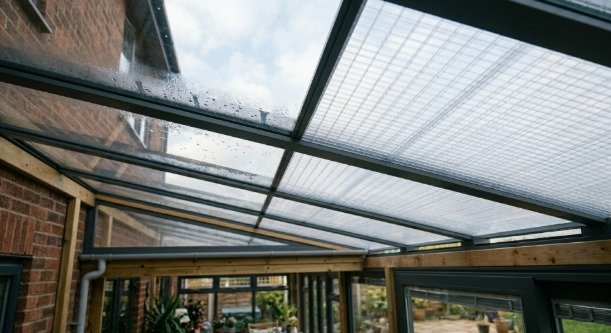
It forms on the underside face of the sheet. It is visible as droplets on the surface below the sheet, dripping into the space underneath. This is a ventilation problem, not a sealing problem.
Internal condensation occurs inside the sheet flutes or chambers and is mainly caused by moisture entering through poorly sealed sheet ends. In contrast, surface condensation forms on the underside face of the sheet when warm moist air comes into contact with a cold sheet surface.
The fix for one will not solve the other. Applying more sealant when surface condensation is the problem makes things worse, not better.
Why Internal Condensation Happens
Hollow chambers extend the entire length of multiwall polycarbonate sheets. These spaces hold air. When the sheet cools (during rain, at night, or after a temperature drop), the moisture in the humid air condenses on the interior surfaces of the chambers.
Polycarbonate naturally absorbs moisture from the air because to its hygroscopic nature. The compartments cannot be completely made impermeable. In some UK weather conditions, a little amount of interior condensation is inevitable. However, one of these particular installation mistakes is nearly usually the reason for persistent severe condensation:
- Anti-dust filter tape applied on a damp day or to a wet sheet surface
- Filter tape fitted with creases that allow air and moisture into the flutes
- Drip trim not sealed at the leading edge with compatible silicone
- Poor quality drip trim that cracks or warps after one or two winters
- Sheets stored in damp conditions before installation day
- Top end of the sheet sealed with breather tape instead of solid sealing tape
That last point is one that catches people out regularly. Breather tape goes at the bottom of the sheet. Solid aluminium tape goes at the top. Fitting them the wrong way around creates exactly the conditions for persistent internal condensation.
Why Surface Condensation Forms on the Underside
Surface condensation has a completely different cause. It forms when warm, moisture-laden air from inside a structure meets the cold surface of the polycarbonate roof sheets above. The air cools, cannot hold its moisture, and deposits it as droplets on the sheet’s underside.
This is a temperature differential and ventilation problem. It is particularly common in enclosed structures with poor airflow.
Surface condensation commonly forms in enclosed garages or workshops where warm moist air becomes trapped inside with little to no airflow. It can also occur on roofs with a pitch below 5 degrees, where condensation tends to pool instead of running off. North-facing structures are more prone to condensation because the sheet surface stays colder for longer, increasing the temperature difference between the air and the sheet. Additionally, high internal humidity caused by cooking, washing, or plant activity in enclosed spaces can further contribute to surface condensation.
A UK homeowner dealing with this exact problem on a forum removed one panel to create a 9-inch gap at the top of the structure. The roof was completely dry the following morning. That simple change in airflow resolved what months of additional sealing had failed to fix.
The Correct Way to Seal Sheet Ends
Getting the sealing right at installation stage is the primary way to prevent internal condensation in multiwall polycarbonate sheets. Every step in this sequence matters and skipping any one of them creates a condensation risk.
Follow this sequence for every sheet:
- Ensure all sheets are completely dry before starting. Never install on a wet or damp day
- Apply solid aluminium sealing tape to the top end of every sheet, pressed flat without creases
- Apply anti-dust breather tape to the bottom end. This is ventilation tape and must not be replaced with solid tape
- Push the aluminium endstop bar over the breather tape at the bottom, leaving a 4mm gap between the tape face and the inside of the bar
- Run a continuous bead of low-modulus neutral-cure silicone along the leading edge of the endstop bar against the sheet face
- Seal all joints between endstop bar sections with the same compatible sealant
The 4mm gap at step four is specific and important. It allows air circulation inside the sheet while the endstop bar keeps dust and insects out. Pushing the bar on too far closes that gap and blocks the ventilation the sheet needs to manage moisture.
How to Fix Surface Condensation with Better Ventilation
Condensation under polycarbonate roofing on the surface of the sheet responds to ventilation, not to sealing. Adding more tape or sealant when surface condensation is the problem traps more humid air rather than allowing it to escape.
Practical ventilation fixes that work:
- Ridge vents along the ridgeline allow warm moist air to escape at the highest point of the roof
- Eaves vents create a cross-flow of air from the low edge to the high edge
- A gap at the top of the structure, even a small one, prevents air stagnation inside the space
- A dehumidifier inside an enclosed structure reduces internal moisture before it reaches the polycarbonate roof sheets above
- Minimum 5-degree roof pitch allows any condensation to run off
In well-ventilated structures with a reasonable pitch, surface condensation rarely becomes a persistent problem. In enclosed, low-pitch, north-facing structures with high internal humidity, multiple ventilation measures used together are more effective than any single fix.
Does Sheet Thickness or Type Make a Difference?
Yes, meaningfully so. Thicker sheets have better thermal performance, which reduces the temperature differential between the inside and outside surface of the sheet. A smaller temperature differential means less surface condensation.
If you are specifying polycarbonate roofing sheets cut to size for a project where condensation is a known risk, the sheet choice is worth thinking about carefully before ordering.
10mm multiwall sheets have a higher risk of internal condensation due to their thinner chambers and lower insulation performance, while the surface condensation risk is considered moderate. In comparison, 16mm multiwall sheets offer better thermal performance, resulting in a lower risk of both internal and surface condensation. Among multiwall options, 25mm multiwall sheets provide the lowest condensation risk because of their superior insulation properties. Solid polycarbonate sheets, on the other hand, have no risk of internal condensation since they contain no hollow chambers, while their surface condensation risk remains low due to their good thermal mass.
Because solid polycarbonate roofing sheets don’t have any hollow spaces for moisture to gather, internal condensation is completely eliminated. Although they are more costly and heavier than multiwall, switching to solid sheets eliminates interior condensation in projects where it has been a recurring issue rather than treating it with ventilation and sealing.
When Is Condensation Normal and When Is It a Problem?
Some condensation in the first few months after installation is normal. Polycarbonate needs a settling-in period, particularly in the UK where temperature swings between seasons are significant. Minor internal condensation that disappears during the warmer part of the day is not a product defect and does not require intervention.
Condensation under polycarbonate roofing becomes a problem that needs addressing when:
- It is persistent and visible for days or weeks regardless of weather conditions
- It pools visibly inside the sheet chambers rather than dispersing
- It drips noticeably into the space below
- It has caused discolouration or algae growth inside the sheet
The next stage is to check the drip trim for cracks and the glazing bar joints for gaps if polycarbonate roofing sheets cut to size have been properly attached with the appropriate tapes, endstop bars and sealant and condensation persists after the settling-in time. These are typical water entry locations that don’t usually appear right away after installation.
One Thing Worth Doing Before Installation
The best way to avoid condensation is to take action prior to the first sheet being raised. Until the day of installation, keep each sheet flat and in a dry place. On the day of installation, sheets that have been left outside, stored upright, or maintained in a wet shed already contain moisture that will turn into condensation after the roof is sealed.
Before fitting, give sheets at least 24 hours to acclimatise to the installation site’s ambient temperature. Before beginning, make sure that all accessories are present. The precise space that condensation needs to take hold is created when sealant runs out midway through and the job is completed the next day.
Although solid polycarbonate roofing sheets do not require the same end-sealing procedure as multiwall, dry storage and cautious handling prior to installation are still beneficial because any moisture on the surface of a solid sheet at installation becomes trapped after the fixings are inserted. After the fasteners are inserted, any moisture that was present on the surface of a solid sheet during installation becomes trapped.