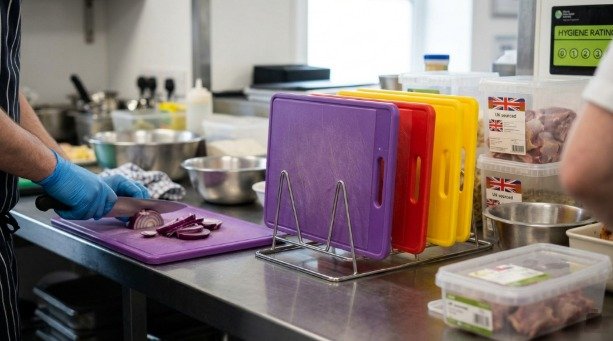
Most UK food businesses already have a colour-coded board system in place. The question that arose after Natasha’s Law is whether a dedicated allergen chopping board is actually necessary, or whether the existing system already adequately covers the risk.
The short answer, based on what food businesses across the UK consistently report, is yes. A dedicated allergen board changes how allergen risk is managed at the prep surface level, in ways the standard colour system cannot replicate on its own.
Here is the full picture.
What Is an Allergen Board and Why Does It Exist?
An allergen board is a dedicated prep surface used exclusively for allergen-controlled food preparation. It is an additional physical control at the surface level.
The purple board is the UK standard colour for allergen-controlled prep. Its existence became significantly more important after Natasha’s Law came into force in October 2021. That legislation, named after Natasha Ednan-Laperouse, who died aged 15 after eating a baguette containing undeclared sesame seeds, covers 14 major allergens and applies to every UK food business regardless of size.
The 14 major allergens under UK food law: Common food allergens can be found in a wide range of everyday products and ingredients. Celery is often present in stocks, soups, and salads, while cereals containing gluten are commonly found in bread, pasta, and flour-based products. Crustaceans such as prawns, crab, and lobster are frequent seafood allergens, whereas eggs are regularly used in baked goods and sauces. Fish can also appear in sauces and dressings. Lupin is sometimes used in flour and baked goods, while milk is commonly found in dairy products and sauces. Molluscs include foods such as oysters, mussels, and squid. Mustard is often added to dressings and marinades, and nuts are commonly used in pesto, baked goods, and sauces. Peanuts can be present in oils, sauces, and snacks, while sesame is often found in bread, oils, and hummus. Soya is widely used in tofu, sauces, and dairy alternatives. Sulphur dioxide is commonly used in dried fruits, wine, and preserved meats. The allergen board UK standard exists because allergen cross-contact at the prep surface is one of the most common and most preventable points of failure in commercial kitchen allergen management.
Why Your Existing Colour Board System Is Not Enough on Its Own
This is the part that catches most food businesses off guard.
The standard colour-coded chopping boards system is designed to prevent microbiological cross-contamination between food types. Raw meat stays on red. Fish stays on blue. That separation works well for its intended purpose. Allergen cross-contact is a different risk entirely, and it requires a different level of control.
A green board used for salad prep can transfer sesame residue to a customer’s meal even after washing. Standard cleaning removes bacteria effectively. It does not necessarily remove allergen traces to the level required for a genuinely allergen-safe preparation environment. Allergen removal requires a verified cleaning process, not just a rinse and wipe.
The key difference: Microbiological cross-contamination is controlled using colour-coded boards and hot washing procedures, with verification carried out through visual inspections and temperature log checks.
Allergen cross-contact is managed through dedicated surfaces and allergen-specific cleaning processes, with verification completed through written cleaning records in the FSMS. A catering chopping board system that handles allergen orders on the same surfaces as standard prep, even with thorough cleaning between uses, relies entirely on human process compliance under service pressure. That is a significant point of failure in a busy kitchen.
What UK Food Businesses Actually Say About Allergen Boards
The experiences vary by operation size and type. What they share is a consistent theme: the purple board made allergen management visible in a way that verbal processes alone could not achieve.
What Small Cafes and Delis Say
Staff confidence was the most commonly cited benefit. When a dedicated purple board is in place, the response to an allergen query at the counter becomes a physical demonstration. Staff reported fewer misunderstandings between the front of house and kitchen, and customers reported feeling more reassured by being able to see the process.
What Restaurant Kitchens Say
In a restaurant kitchen running a full service, verbal communication about allergen orders is vulnerable to noise, pace, and distraction. A commercial chopping board designated specifically for allergen prep made the allergen ticket visible and trackable. Head chefs reported it reduced their reliance on verbal handoffs during service, which are the most common point at which allergen information gets lost or misheard.
What High-Volume Catering Operations Say
At volume, process-based allergen separation is genuinely difficult to maintain consistently across a full brigade. A dedicated surface removes the human judgement element of whether a board is clean enough for allergen-sensitive prep. It either is the allergen board, or it is not. That binary clarity is what high-volume operations said mattered most.
Does Not Having One Put You at Risk?
No specific law mandates a purple allergen board by name. What the law does require is that allergen cross-contact risks are identified, controlled, and documented within the food safety management system.
In March 2025, the FSA updated its allergen guidance for the out-of-home sector. The updated guidance encourages written allergen information, staff training that covers allergen severity, and systems that customers can access without having to ask directly. The direction of travel in UK allergen regulation is clearly toward more documentation and more physical evidence of control.
What an EHO assessing allergen controls will look for:
● A documented allergen control process in the HACCP plan
● Evidence that staff are trained on allergen cross-contact risk
● Physical separation measures at the prep surface level
● A food-safe chopping board designated for allergen use, clearly identified and stored separately
A purple board documented in the HACCP plan is one of the clearest, cheapest, and most auditable ways to demonstrate physical separation. Not having one means the business is relying entirely on process controls that are harder to evidence and easier to challenge.
What a Dedicated Allergen Board Actually Changes
Coloured chopping boards in the standard six-colour system do a specific job well. Adding a seventh for allergen-controlled prep does something different. It changes the allergen management process from invisible to visible.
Four specific things UK food businesses report after adding a dedicated allergen board:
Staff confidence improves immediately
The grey area of whether a surface is clean enough for allergen-sensitive prep disappears. The purple board is either in use or it is not. That clarity matters under service pressure.
Customer conversations become easier
Being able to point to a physical dedicated surface adds credibility to allergen assurances in a way that verbal responses alone cannot match. Customers with serious allergies notice the difference.
EHO inspections become more straightforward
A purple board documented in the HACCP plan with its own cleaning verification step demonstrates a proactive physical control. That is easier to evidence than a process-based approach that relies on staff recollection.
Incident risk at the surface level reduces
Physical separation is more reliable than process-based separation during a busy service. A dedicated board removes the human error risk of a surface being used for standard prep between allergen orders without proper cleaning verification.
What to Look for in a Dedicated Allergen Board
Not every board is suitable for allergen-controlled prep. A professional chopping board used for allergen orders needs to meet specific physical requirements that go beyond colour alone. Allergen-safe equipment should have a non-porous surface to prevent allergen residue from embedding into the material and must not contain deep knife grooves where allergen traces can collect and become difficult to clean. It should be used exclusively for dedicated allergen preparation and never for standard food prep under any circumstances. A clearly distinct colour, such as purple which is the UK standard, helps avoid confusion and ensures easy identification, while dishwasher-safe materials are important to guarantee the equipment can be fully sanitised to allergen-removal standards. A worn or grooved allergen chopping board is not a safe allergen prep surface, regardless of its colour. The condition of the board matters as much as its designation. Replacing it when grooves become visible is not optional — it is part of managing the allergen risk the board is supposed to control.
How to Integrate an Allergen Board Into Your Existing System
The allergen board UK addition works best when it is treated as a system change. Buying a purple board and putting it in the drawer with the rest achieves very little.
Five steps to a properly integrated allergen board:
1. Designate a storage location separate from the standard commercial chopping board set — physically apart, not just a different shelf position
2. Document the allergen board in the HACCP plan with its specific use case and cleaning requirements
3. Create a written cleaning verification step specific to allergen removal, separate from the standard cleaning log
4. Train all food handlers on when the board is used and who verifies it is clean before each allergen order
5. Include the allergen board in the monthly condition inspection schedule with a documented replacement trigger
The Honest Verdict
A purple board will not solve an allergen management problem on its own. What it does is make one critical part of the process physical, visible, and documentable in a way that verbal controls simply cannot.
Colour-coded chopping boards already set the standard in UK commercial kitchens. A dedicated allergen board is the next logical step for any food business that takes allergen management seriously.
The cost of a dedicated prep surface is minimal. The cost of an incident traced back to a shared prep surface is not. That calculation is why UK food businesses that have added one consistently say they would not go back to managing allergen orders without it.