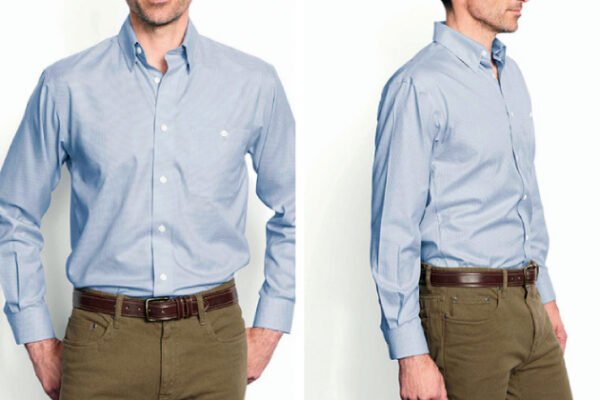
Early on a workday, you open the closet and find your favorite dress shirt looking like it spent the night balled up in a gym bag. You have two options: stand at the ironing board for ten minutes, or reach for the non-iron shirt next to it and get on with your day.
Anyone who owns both types knows the dilemma. But the choice isn’t only about saving a few minutes. Each kind of shirt has real advantages, a few drawbacks, and moments when it’s clearly the better pick. Here’s how to decide which one belongs on your back.
Understanding the Difference
A standard dress shirt is typically made of untreated cotton. It’s soft and breathable, but its fibers move around when they’re washed, worn, or squashed in a drawer, and that’s why it wrinkles so easily.
A conventional non-iron shirt is usually cotton that has been given a chemical finish. Using heat, the finish locks the fibers into position so they resist creasing, much like permanent press treatments. The shirt comes out of the wash far smoother than untreated cotton would.
There’s also a newer group: performance dress shirts that fight wrinkles through the cloth itself, often by blending cotton with a small share of stretch fiber. They look like a classic dress shirt but behave more like a non-iron one.
A quick way to sort them:
- Regular dress shirt: The softest, most natural feel, but the most wrinkling and the most upkeep.
- Treated non-iron shirt: The smoothest result after washing. It can feel a little stiffer, and the finish may fade with time.
- Wrinkle-resistant performance shirt: Stretch and easy care, though how it feels depends heavily on fabric quality.
When a Non-Iron Shirt Makes Sense
These shirts earn their spot when convenience and consistency matter most.
Packed workweeks. If you wear a dress shirt five days in a row, the ironing time you skip adds up fast. Wash it, hang it, wear it.
Business trips. Hotel irons are hit or miss, and suitcases are rough on fabric. A shirt that bounces back quickly is a real asset when you land and head straight into a meeting.
Long days. Untreated cotton can look worn out by mid-afternoon, particularly at the waist and elbows. Non-iron and wrinkle-resistant shirts keep a cleaner appearance through hours of sitting, driving, and moving around.
Events with no time to spare. Weddings, conferences, and multi-day gatherings often mean getting dressed quickly in unfamiliar places.
One honest note: “non-iron” doesn’t mean wrinkle-proof. How you wash, dry, and store the shirt still makes a big difference. If yours keep coming out rumpled, the cause is usually something in your laundry routine that can be fixed.
When a Regular Dress Shirt Wins
Untreated cotton still has a strong case for certain people and occasions.
You like a crisp press. Some men simply love the sharp collar and razor-straight placket that only fresh ironing or professional pressing delivers.
Very formal events. For black tie, many men prefer a freshly pressed cotton shirt, often with a specific collar or bib style that’s hard to find in non-iron versions.
Hot, humid weather. Plain cotton tends to feel light and soft on the skin. Some treated shirts breathe a little less, although this varies a lot by brand and fabric.
You use a laundry service. If your shirts go to the cleaners every week anyway, easy care matters much less.
Comfort and Durability Compared
This is where the differences get more subtle.
Chemical wrinkle-resistant finishes have long carried trade-offs. The treatment can make cotton fibers less flexible and, over time, weaker. Manufacturing has improved a great deal, but a heavily treated shirt can still feel stiffer than plain cotton, especially when new.
Stretch is another factor. Most traditional dress shirts, treated or not, have no give. If your day involves reaching, commuting, or carrying a bag, a shirt with some stretch makes a noticeable difference.
Fit matters for both types too. A shirt that pulls across the chest or balloons at the waist wrinkles faster whatever it’s made of. If you’re unsure which cut suits your build, trying a slim and a regular fit side by side is a good place to start.
What to Look For in a Wrinkle-Resistant Shirt
If you’re leaning toward easy care, a few features separate a good shirt from one that simply feels stiff:
- Fabric quality. Long-staple cottons such as Supima or Egyptian tend to feel softer and last longer.
- Stretch content. A small percentage of stretch fiber adds comfort without making the shirt look casual.
- Breathability. Important if you run warm or live somewhere hot.
- Stain and odor resistance. Handy for long days and travel.
- Care instructions. Check whether special washing is needed and whether the shirt tolerates a dryer.
As one example, xSuit’s xShirt 5.0 uses a blend of 91% Supima cotton and 9% spandex, and is described as wrinkle-, stain-, and odor-resistant with four-way stretch. It comes in modern and slim fits. Its care notes are worth knowing: the brand recommends hanging it to dry instead of tumble drying, and advises against alterations.
Building a Wardrobe With Both
For most men, it isn’t a matter of picking one type for life. It’s a matter of deciding which one does the heavy lifting.
- If you wear dress shirts daily or travel often, let wrinkle-resistant shirts make up most of your rotation, and keep one or two crisp cotton shirts for formal events.
- If you wear them only occasionally, regular cotton is fine, with one easy-care shirt set aside for trips and rushed mornings.
- If you’re starting from scratch, begin with white and light blue, which pair with nearly every suit.
Making Your Choice
The right shirt depends on your week, not on a universal rule. Ask yourself:
- How often do I wear dress shirts, and how much time am I willing to spend ironing?
- Do I travel often, or spend long, active days in my shirts?
- Do I prefer the crisp feel of pressed cotton or the comfort of stretch and easy care?
- Does my laundry routine suit untreated cotton, or would simpler care make life easier?
If convenience, travel, and long days define your routine, a non-iron or wrinkle-resistant shirt will probably serve you better. If you love a freshly pressed finish and have the time, regular cotton still earns its place. Plenty of men end up with a mix of both, which is often the smartest wardrobe of all.