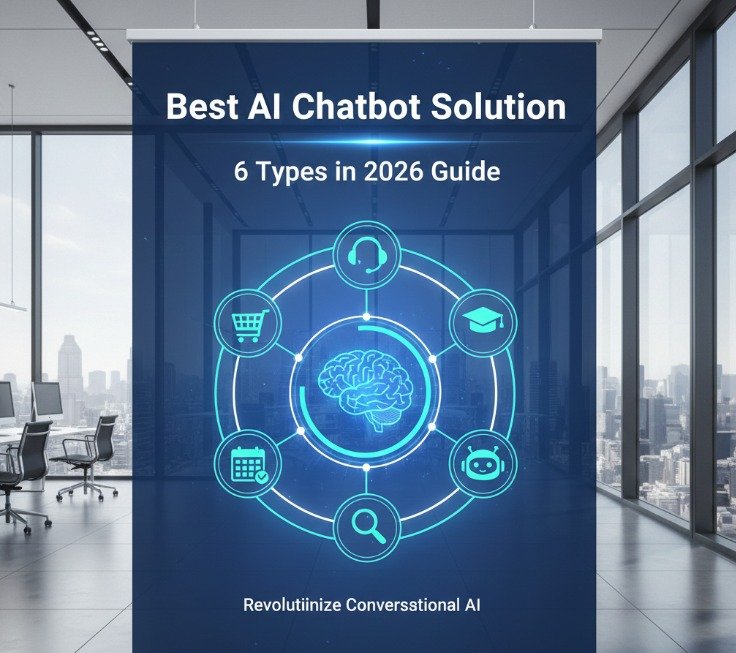
Every company wants automation. Every website wants instant replies. Every team wants fewer repetitive questions. But here is the real challenge. Not all chatbots are the same. Some follow scripts. Some understand intent. Some generate answers from scratch. Others pull from secure company data. Choosing the Best AI Chatbot Solution in 2026 is not about picking the smartest-sounding tool. It is about picking the right type for your business needs. Before you invest, you must understand the six major types of AI chatbots and how they truly differ.
The 6 Types of AI Chatbots in 2026
Technology has evolved fast. Chatbots are no longer simple pop-ups. They come in different architectures, each designed for a specific purpose.
1. Rule-Based Chatbots
These are the most basic kinds. They rely on set scripts and clear decision paths. Users choose options by clicking buttons. The bot replies with prepared responses. They are useful for simple tasks like scheduling or answering common questions. But they cannot handle unexpected questions. If the user steps outside the script, the system fails. Rule-based bots are predictable. They are safe. But they are limited.
2. AI-Powered Chatbots
Powered by natural language processing, these bots identify user intent more accurately. They are more dynamic than rule-based programs. Rather than scanning for single words, they evaluate message context. This helps them respond to different sentence styles. They enhance customer conversations. Still, without a clear knowledge structure, responses may not always be steady.
3. Generative AI Chatbots
These bots generate responses dynamically. They are creative. They are conversational. They can answer complex questions. However, they require guardrails. Without boundaries, they may produce incorrect or unpredictable responses. Generative models are powerful but demand careful oversight.
4. Retrieval-Based Chatbots
These bots search within uploaded documents and return relevant information. They do not invent answers. They retrieve them. This reduces risk and increases reliability. Many enterprises prefer this method because it protects data integrity. Retrieval systems are especially common in secure environments.
5. Hybrid Chatbots
Hybrid bots combine rule-based logic with AI understanding. They offer structured workflows alongside flexible conversations. This balance provides control and adaptability. Many modern systems use this model because it blends safety with intelligence.
6. AI Agents
AI agents go beyond answering questions. They perform actions. They connect to systems. They trigger workflows. An AI agent platform for business allows these agents to automate tasks across tools and departments. This type moves from conversation to execution. It represents the next stage of chatbot evolution.
Key Differences Between Chatbot Types
Understanding the six types is only the first step. Now, let us break down the key differences that truly matter.
Intelligence Level
Rule-based bots follow scripts. AI-powered bots interpret meaning. Generative bots create responses. Retrieval bots pull from stored knowledge. AI agents take action. The deeper the intelligence, the greater the flexibility. But flexibility also requires stronger control.
Risk and Reliability
Rule-based systems are safe but offer limited flexibility. Generative systems are strong yet need clear controls. Retrieval-based systems are more reliable because they pull answers from verified sources. Many companies select an Enterprise-grade AI chatbot when stability matters more than creativity.
Scalability
Basic bots handle simple queries. Advanced systems manage thousands of complex interactions at once. Hybrid and agent-based systems scale more effectively in growing businesses.
Integration Depth
Some bots work only on websites and answer questions there. Others link with CRMs, internal databases, and communication tools. A modern AI chatbot platform usually supports wider integration across business operations.
Cost and Complexity
Rule-based bots are simple to launch and quick to manage. Generative and hybrid models need careful planning and strong oversight. As systems become more advanced, the setup must be more thoughtful and structured to ensure long-term success.
Summary Table
| Feature | Basic Chatbots | Advanced AI Bots | AI Agents |
| Intelligence | Script-based | Context-aware | Action-driven |
| Risk Level | Low | Medium | Managed with controls |
| Flexibility | Limited | High | Very High |
| Integration | Simple | Moderate | Deep |
| Business Impact | Task support | Customer engagement | Process automation |
This comparison helps clarify why the right choice depends on goals, not trends.
How to Choose the Right One for Your Business
Now comes the important question. Which type should you choose? Start with clarity. What problem are you solving?
- If your goal is simple FAQ support, a rule-based chatbot can handle the job.
- If you want more natural conversations, AI-powered systems work better.
- If your business manages sensitive information, retrieval-based models offer stronger protection.
- If you want automation across departments, AI agents may be the future path.
Also consider industry needs. A healthcare company may prioritise accuracy. An e-commerce brand may prioritise engagement. Many companies review platforms like GetMyAI to see how hybrid and retrieval models handle real business needs with controlled risk. The best choice is not always the most complex tool. It is the one that fits your actual goals.
Think First, Then Automate
Many companies rush into automation because it sounds modern and exciting. Some jump straight into generative systems without knowing why they need them. Others stay with very basic tools for too long. Both paths create problems. Real progress comes from balance and clear thinking.
Here are five mistakes to watch carefully:
- Adopting tools without clear goals
- Holding onto outdated chatbot scripts
- Ignoring important governance standards
- Deploying before proper testing
- Failing to plan for the long term
Great performance begins with thoughtful planning.
What Comes Next for Smart Conversations
Chatbots are growing into smart digital agents. They do more than reply to simple questions. They help guide tasks, manage steps, and support daily work. Many systems now mix retrieval accuracy with generative flexibility. This means they can pull trusted information while still responding naturally.
As technology advances, chatbots will adjust responses based on user role, situation, and specific needs. Businesses that prepare now will create stronger systems for the future. Automation does not replace people. It helps teams, reduces repetitive tasks, and improves digital experiences for all.
Conclusion
Choosing the best solution requires understanding the six types available in 2026. Each has strengths. Each has limits. From rule-based scripts to AI agents, the right decision depends on your goals, risk tolerance, and integration needs. When selected wisely, an AI Chatbot for Business becomes more than a support tool. It becomes a growth engine that improves efficiency, consistency, and customer trust. The key is simple. Know your needs. Understand the differences. Then choose with confidence.