Have you ever pulled a favorite red shirt from the washing machine, only to find it has turned a dull pink and tinted all your whites? That disappointing moment is a real-world example of poor colour fastness to washing. For textile manufacturers, retailers, and quality control professionals, preventing this scenario is a non-negotiable part of their job.
Ensuring that fabrics can withstand the rigors of laundry without fading or bleeding is critical for brand reputation and customer satisfaction. But how is this quality measured objectively? This comprehensive guide will walk you through everything you need to know about colour fastness to washing, from the basic principles and international standards to the advanced technology that makes precise testing possible.
What is Colour Fastness to Washing?
Colour fastness to washing refers to a fabric’s ability to retain its original color during a washing process. It’s a measure of how resistant the dye or pigment is to the various elements of a wash cycle, including:
- Detergents and chemicals
- Mechanical agitation
- Specific water temperatures
- Rinsing and drying procedures
A material with high colour fastness will show minimal color change and will not stain other fabrics washed alongside it. This property is essential for all types of textiles, including cotton, linen, silk, wool, and synthetic fibers. Without standardized testing, predicting how a fabric will behave after its first trip to the laundry would be impossible.
The Science Behind the Test: How It Works
While home laundry is unpredictable, laboratory testing follows strictly controlled methods to ensure reliable, repeatable results. The core principle involves simulating a wash cycle under specified conditions to assess two key outcomes:
- Color Change: How much the original fabric’s color fades or alters.
- Color Staining: How much color transfers from the test fabric to other materials (like a multi-fiber strip) during the wash.
The process is designed to replicate the mechanical and chemical actions of a standard wash. To simulate friction, stainless steel balls are added to the test container. A low liquor ratio (the amount of wash liquid relative to the fabric) ensures the mechanical action is concentrated and consistent, mimicking real-life conditions in an accelerated manner.
The Step-by-Step Procedure
- Sample Preparation
- Cut the fabric into a specified size, typically 100mm x 40mm.
- Attach the sample to a piece of multi-fiber fabric or sandwich it between two pieces of single-fiber fabric by stitching along one side. This “adjacent fabric” will catch any dye that runs.
- For yarns or loose fibers, they are either woven into a fabric or an equal weight is stitched between two lining fabrics.
- The Washing Process
- The prepared specimen, along with the specified number of steel balls and the correct volume of wash liquor, is placed into a stainless steel test cup.
- The cups are sealed and loaded onto a rotating rack within the tester.
- The water bath is heated to the precise temperature required by the test standard (e.g., 40°C, 50°C, or 60°C).
- The machine runs for a set time, agitating the cups to simulate the mechanical action of a washing machine. The temperature and rotation speed are carefully monitored throughout.
- Rinsing and Drying
- Once the cycle is complete, the test specimen is removed from the cup.
- It is then rinsed, dried according to the standard’s instructions (usually air-dried at a temperature not exceeding 60°C), and prepared for evaluation.
- Result Evaluation
- The dried specimen is compared against the original, untested fabric.
- Both the color change of the specimen and the staining on the multi-fiber fabric are assessed. This is done visually in a light cabinet using standardized Grey Scales, or instrumentally using a spectrophotometer for objective data.
The results are rated on a scale from Grade 1 to Grade 5:
- Grade 5 (Excellent): No color change or staining is detectable.
- Grade 4 (Good): Slight change or staining is noticeable.
- Grade 3 (Fair): Moderate change or staining is evident.
- Grade 2 (Poor): Significant change or staining occurs.
- Grade 1 (Very Poor): Severe color change or staining.
The Critical Role of International Standards
For a test result to be meaningful, it must be reproducible anywhere in the world. This is why international standards are the backbone of textile testing. They define every variable: sample size, temperature, time, detergent type, and the number of steel balls. Adhering to these standards ensures consistency, builds trust between suppliers and buyers, and guarantees product quality.
A modern colour fastness to washing tester must be versatile enough to perform tests according to multiple key standards. These include:
- ISO 105-C06: The primary international standard, with various conditions (e.g., A1S at 40°C, B2S at 50°C, C2S at 60°C) to simulate different wash intensities.
- AATCC 61: The standard commonly used in North America, designed to simulate the effect of multiple home or commercial launderings (like 5 home washes) in a single, accelerated test.
- GB/T 12490 & GB/T 3921: Key standards for the Chinese market.
- JIS L0844: The Japanese Industrial Standard for colour fastness.
- M&S C4A, NEXT TM 02: Important retailer-specific standards.
Introducing the WashTrue: The Smart Evolution in Testing
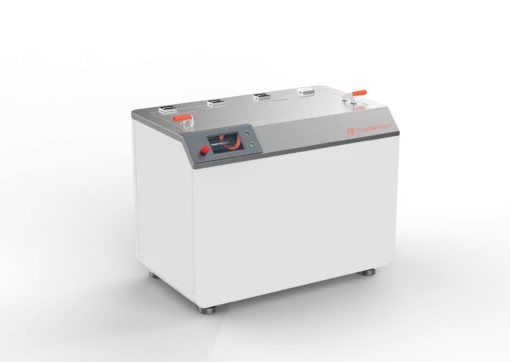
To meet the demands of these rigorous standards and modern lab workflows, equipment has evolved significantly. The WashTrue Colour Fastness Tester, for example, represents a leap forward from traditional machines. It’s not just a container of water that spins; it’s an intelligent system designed for accuracy, efficiency, and connectivity.
Let’s explore the features that set a modern, smart tester apart:
- Intelligent Precision and Control
The heart of a reliable test is precise control. An advanced machine utilizes an intelligent temperature control algorithm to heat the water accurately and maintain it within ±2°C of the set point. This ensures that the test conditions are exactly as the standard requires, eliminating a major source of error.
- A User-Friendly, Automated Experience
Gone are the days of complex dials and manual logging. A large, intuitive touch screen puts the entire test program at your fingertips. You can easily:
- Select pre-programmed international test standards.
- Manually adjust parameters like temperature, time, and heating rate.
- Start, pause, or stop tests.
- Initiate automated functions like water filling and drainage (with safety locks to prevent draining hot water above 70°C).
The system automatically logs all sample data, test steps, and final results, compiling them into comprehensive, ready-to-use test reports. This minimizes human error and frees up technicians for other tasks.
- The Power of IoT and Connectivity
The most significant advancement in modern testers is connectivity. With built-in IoT technology, the WashTrue can connect to lab management systems via an open API or to a smartphone app like SmarTexLab. This offers unprecedented control:
- Remote Monitoring and Control: Start, stop, or adjust tests remotely from your phone or PC.
- Real-Time Alerts: Get notifications before a test finishes or if maintenance is required.
- Centralized Data Management: View reports from multiple instruments in one place, ensuring all stakeholders have real-time access to quality data.
- OTA Updates: The machine’s firmware can be updated remotely, ensuring it always has the latest features and standards.
- Robust and Durable Design
A lab instrument must be built to last. High-quality testers feature tanks made from durable SUS316 stainless steel for corrosion resistance. They also incorporate safety features like protection against motor heat damage and dry burning, and use controlled solid-state relays for reliable, long-life heating.
Single vs. Dual Cylinder: Choosing the Right Model
Laboratory needs vary, so colour fastness testers often come in different configurations. The choice between a single and dual-cylinder model depends on your testing volume and flexibility requirements.
- Single-Cylinder Model: Ideal for laboratories with lower testing frequencies or smaller batch sizes. It’s a cost-effective solution for routine quality control when the number of samples is manageable.
- Dual-Cylinder Model: This is the choice for high-throughput industrial environments. The key advantage is the ability to run two independent tests simultaneously. For instance, one cylinder could be performing a standard ISO 105-C06 test at 40°C, while the other runs an AATCC 61 test at 60°C. This effectively doubles your testing capacity and greatly enhances efficiency.
Interpreting Your Results and Ensuring Accuracy
Once a test is complete, you’ll have a clear, quantitative result. A high grade (4 or 5) tells you the fabric has excellent colour fastness, meaning its dyeing process was successful. A low grade (1 or 2) signals a problem, perhaps with the dye selection, the dyeing method, or the need for better post-treatment washing.
To ensure your results are always accurate, regular verification of the equipment is key. Many advanced testers simplify this with a built-in calibration interface:
- Enter the calibration mode and select a five-point check.
- Set the machine to a low target temperature.
- When it reaches the target, record the actual temperature with a calibrated external thermometer.
- Input this measured value into the machine.
- Repeat for four other temperature points and save. This simple process ensures your machine’s readings are always spot-on.
Conclusion
In the world of textiles, quality is not an accident; it is the result of meticulous testing and control. Mastering colour fastness to washing is fundamental to delivering products that look great and last long, protecting both the consumer’s wardrobe and the brand’s reputation. From understanding the basic principles of the Grey Scale to leveraging the power of smart, connected instruments like the WashTrue, investing in the right knowledge and technology is essential. It transforms a simple wash test from a routine check into a powerful tool for quality assurance, innovation, and customer trust.
Reach directly to Sales Contact:
- WhatsApp: +86 180 2511 4082
- Tel: +86 769 2329 4842
- Fax: +86 769 2329 4860
- Email: sales@chiuvention.com