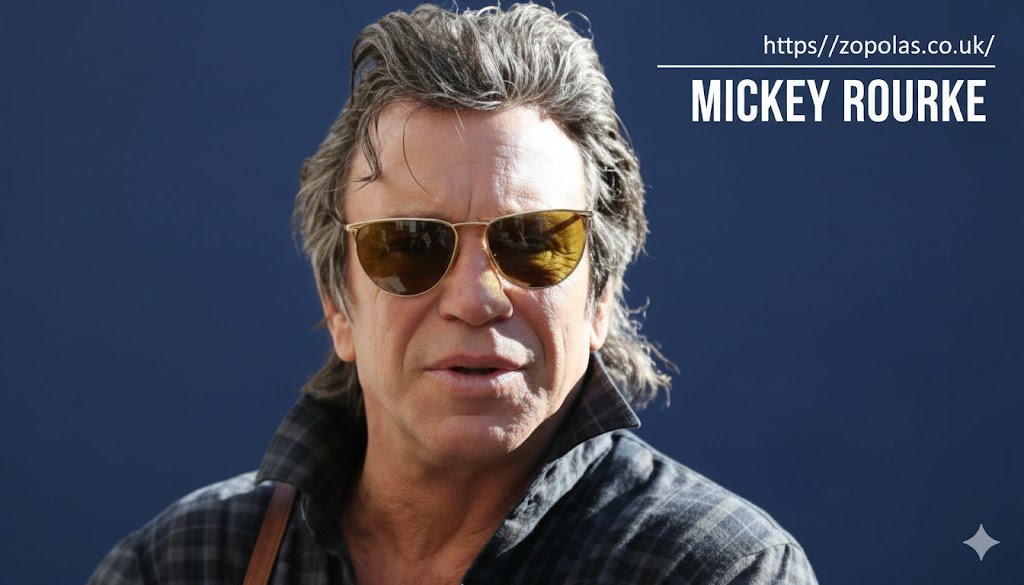
Mickey Rourke, an actor known for his brooding intensity and raw, unfiltered performances, is one of Hollywood’s most fascinating figures. His career spans several decades, marked by meteoric rises, dramatic falls, a brief career as a professional boxer, and a highly publicized physical transformation. Whether you know him from his iconic roles in the 1980s or from his comeback in the 2000s, Mickey Rourke’s story is one of rebellion, resilience, and reinvention.
Early Life: The Beginnings of a Star
Born Philip Andre Rourke Jr. on September 16, 1952, in Schenectady, New York, Mickey Rourke’s early life was far from glamorous. Raised in a working-class family with an abusive stepfather, Rourke found solace in sports, particularly boxing. By his teenage years, Rourke was already an amateur boxer, showing promise in the ring. His path to Hollywood, however, would be far from typical.
After moving to Miami, Rourke developed an interest in acting and eventually attended the Lee Strasberg Theatre Institute in New York, where he began to cultivate his passion for performing. While boxing gave him a tough, gritty edge, it was his acting that would bring him lasting fame.
The Rise to Fame: 1980s Hollywood Heartthrob
Rourke’s big break came in the early 1980s with films like “Body Heat” (1981) and “Diner” (1982), but it was his role in “9½ Weeks” (1986) that truly made him a household name. In this film, Rourke’s chemistry with co-star Kim Basinger created a storm of media attention and marked him as one of the era’s most desirable leading men.
By the late ‘80s, Rourke was one of Hollywood’s brightest stars, known for his intensity and his ability to portray tortured souls on screen. He earned critical acclaim for his work in “Angel Heart” (1987), a psychological thriller that pushed boundaries with its dark and mysterious themes.
However, the success wasn’t without its complications. Rourke’s persona was as unpredictable off-screen as it was on-screen. Known for his rebellious nature and disdain for Hollywood’s norms, Rourke’s life began to unravel both professionally and personally, leading to an eventual departure from acting.
The Boxing Years: A Tumultuous Interlude
In the 1990s, at the height of his fame, Rourke made a surprising decision: he left acting behind to pursue a career in professional boxing. His love for the sport and his desire for a new challenge led him to take up boxing full-time, fighting professionally from 1991 to 1994.
Although he was a decent fighter, Rourke’s boxing career ended prematurely due to injuries sustained in the ring. He suffered severe damage to his face, including broken bones and a shattered nose, which would later contribute to his dramatic physical transformation.
The toll that boxing took on Rourke’s body is one of the most talked-about aspects of his life. His facial injuries led to multiple plastic surgeries, which, over time, altered his appearance significantly. These changes would become a point of public fascination and criticism in the years to come.
A Hollywood Comeback: The Wrestler and Beyond
By the mid-2000s, Rourke’s career had all but vanished. He returned to acting with minor roles in independent films, but it was his role in “The Wrestler” (2008) that marked his triumphant comeback. In this emotionally raw performance, Rourke portrayed Randy “The Ram” Robinson, a faded professional wrestler trying to reclaim some semblance of his former glory.
Rourke’s portrayal of The Ram earned him widespread critical acclaim, including a Golden Globe Award and an Academy Award nomination. The performance was a reflection of his own struggles, with Rourke drawing parallels between his life and the character’s journey. This comeback solidified Rourke as a force to be reckoned with in Hollywood once again.
Following his success in The Wrestler, Rourke took on roles in major films like “Iron Man 2” (2010), where he played the villainous Whiplash. Despite mixed reviews, his presence in the film was a reminder of his enduring star power.
Personal Life: Relationships, Struggles, and Public Perception
Mickey Rourke’s personal life has been as turbulent as his career. He has been married twice — first to Debra Feuer, an actress, in the early 1980s, and later to Carré Otis, a supermodel, in the 1990s. His marriage to Otis was fraught with public controversy, including allegations of abuse, and the couple eventually divorced.
Rourke’s relationships have often been under the microscope, and his struggles with fame, addiction, and emotional turmoil have played out in the public eye. Despite these setbacks, Rourke has remained a beloved figure among fans who admire his resilience.
Plastic Surgery and Public Scrutiny
One of the most discussed aspects of Mickey Rourke’s life is his plastic surgery. After his boxing career left him with severe facial injuries, Rourke underwent several reconstructive surgeries. Unfortunately, these surgeries altered his appearance in ways that were often criticized by the public and the media.
Rourke has spoken candidly about his decision to have surgery, attributing it to the need to repair the damage caused by boxing. While some fans have expressed sympathy for his situation, the dramatic changes to his face have sparked mixed reactions over the years. Nonetheless, Rourke has remained unapologetic about his choices and continues to embrace his unique look.
Mickey Rourke Today: Legacy and Future
As of 2025, Mickey Rourke is in his 70s, but he remains active in the entertainment industry. His career may not be as prolific as it once was, but his legacy as an actor who pushed boundaries and defied expectations endures.
Though he’s taken on fewer roles in recent years, Rourke continues to captivate audiences with his presence. His story is one of reinvention, regret, redemption, and ultimately resilience. Rourke’s ability to come back after setbacks — both personal and professional — is a testament to his enduring talent and unique place in Hollywood history.
Despite the controversy and the challenges, Mickey Rourke will always be remembered as one of the most complex and charismatic actors of his generation. His journey is a reminder that success is not just about reaching the top, but about how you rise from the fall.
If you’d like, I can explore specific aspects of his boxing career, major films, or personal life further. Let me know what interests you most!